RPGaDAY 2026
A Month of Prompts in a Single Post

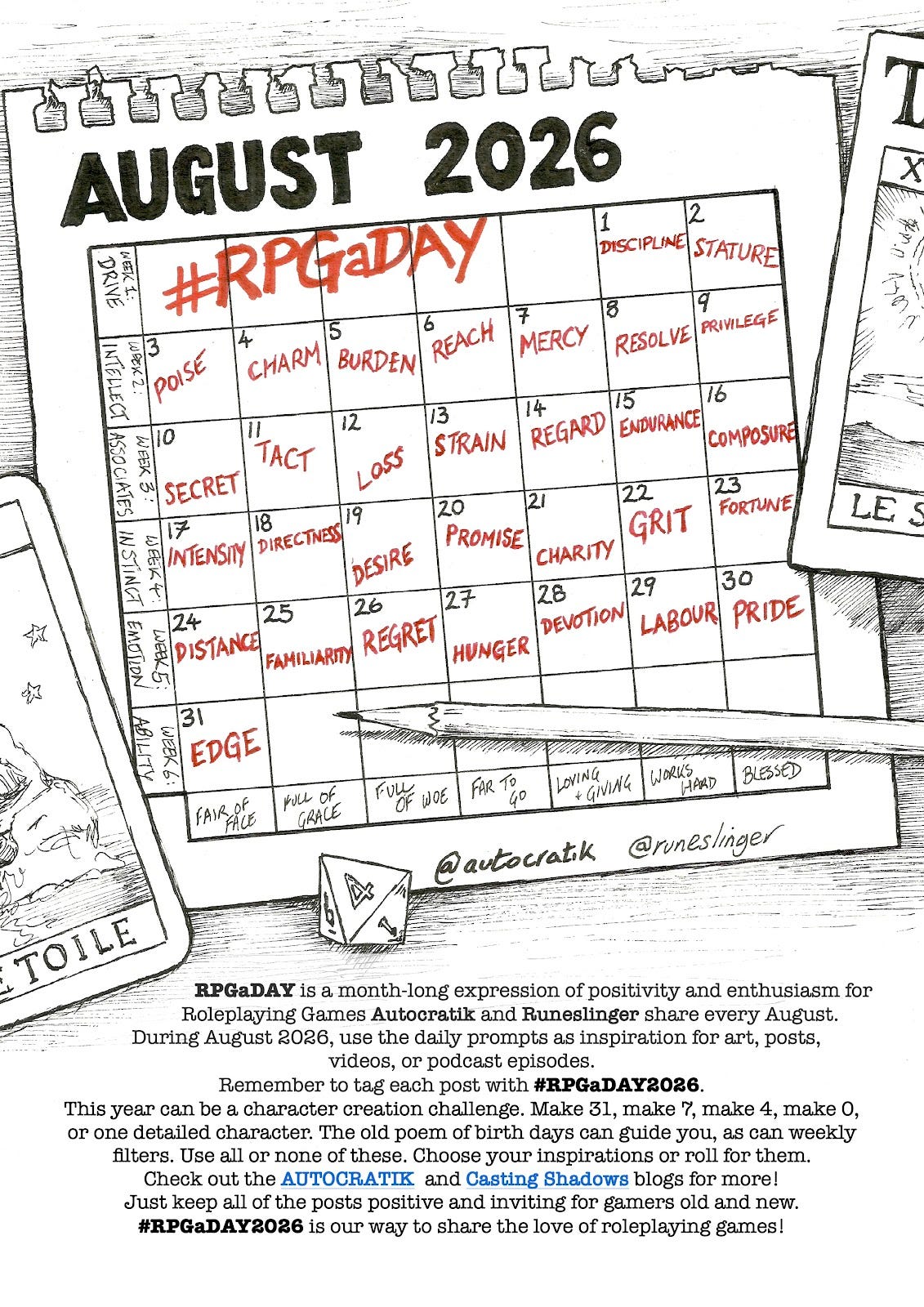
#RPGaDAY2026 is a thing started by Dave Chapman forever ago. 31 single word prompts across the month of August and how they relate to RPGs for the individual answering those prompts. Now, if I do one a day I’ll inevitably fall off the wagon, so here’s all 31 in a single go. I’ll be answering based on the first thing that pops in my head based on the prompt.
Discipline: Vampire: The Masquerade, of course, immediately springs to mind. Disciplines are Vampric powers that range from the tropey (I can turn into a bat!) to the downright weird (I can mold flesh with my hands) to the strange, but somehow appropriate (I can weave the very nature of madness itself). It really pushes the meaning of what a “vampire” is and turns the Kindred of Vampire: The Masquerade a truly multi-cultural presentation of the iconic beast.
Stature: Stature made me think of size, height. Of course, my brain went to my beloved Halflings. Small in stature, great in heart. Just like I like my heroes. I like the “little” races in fantasy roleplaying games: Halflings, gnomes, etc. Being a little hero in a large world is a big deal.
Poise: Made me think of swashbucklers. Whether they be your classic D&D fighters and thieves who relied on speed an Dexterity to the endless variants of the archetype found in 7th Sea, they all had poise.
Charm: Person or Monster?
Burden: This made me think of a card game, which is close enough. The Decipher Lord of the Rings LCG, which came out around the time of the Jackson films and for many years after had a ringbearer (which didn’t necessarily have to be Frodo) earn “Burden.” At 10 Burden, he was corrupted and the amount of Burden in play could impact the adversaries - particularly Nazgul. It was a neat little system.
Reach: My first exposure to Reach as a mechanic was in Shadowrun, where melee combatants had to compare the reach of the weapons they used and the difference would alter the difficulty of attacks and other actions. It was my first exposure to the idea of something beyond a simple “hit or miss” mechanic of D&D and showed me just how damned granular RPGs could get.
Mercy: When Cobra Kai was in its second season, I had the idea (that I never did anything with) for a roleplaying game - White Box-based, of course - called White Belt: A Martial Arts Roleplaying Game of Teenage Angst. Naturally, the famous “Mercy is for the weak” ethos of the Cobra Kais came to mind and I had a system I was developing where your martial arts ethos impacted different elements of battle. I ultimately abandoned the game, but the draft is sitting around somewhere on my drive.
Resolve: This word has a surprising amount of meaning for me. When I was writing The Hero’s Journey, Second Edition I wanted to combine mental and metaphysical endurance. I saw it combined in so many characters: Aragorn and Samwise in particular. The term eventually became “Resolve” and I’m still proud of how elegant and simple it was and how well it worked in play.
Privilege: This word doesn’t really strike me in any RPG context, but I guess it does remind me of Changeling: The Dreaming and one of the key elements of that game being the conflict between the noble Sidhe kith and the other Commoner kiths and even though the Sidhe have been horrifically abusive of their power in the past, should they still rule given that it came as a mandate from The Dreaming itself? Basically can “the plot” be wrong?
Secret: Makes me think of Mage: The Ascension and how all your magic, to avoid reality ripping you apart with an energy called “Paradox” had to appear coincidental. It was a great in-world way to restrict players in a modern world from whipping fireballs down main stream and promote creativity in spellcasting.
Tact: This is something I tend to lack, but I remember the first time I really came at a D&D encounter from a purely tactical bent and got that first taste of “war gamer” joy. It was, oddly enough, from roleplaying. I was playing a D&D 3e, a L/N Samurai from the 3e Oriental Adventures and I basically just played my alignment from a purely combat perspective, took command of the situation, and we trounced an encounter we had no business winning. Very satisfying.
Loss: An old friend of mine just texted me today and said “I miss your old Scion game.” That game was 15 years ago or so. I miss it too. When it comes to loss, I miss all the campaigns that are no more, and more than that I miss all the people I loved gaming with that I’ll probably never game with again.
Strain: “Recover 2 Strain!” Strain for me will always be the term for non-injurious weariness from the Fantasy Flight Games series of Star Wars roleplaying games.
Regard: This is a strange, meandering road. Regard to me always somehow comes back to the word respect. And the biggest thing we disregard, and thereby disrespect, is how much effort GM/DMs put into their games. In the modern era when life gets full of obligations and distractions, we seem to take those to the table with us. I hate distracted gamers - especially willfully distracted gamers. Put the phone down, focus on the game and show some regard for the work the GM has put into the experience you’re having.
Endurance: Ahh, the days when you were a high school kid and you played those marathon sessions that lasted 18 hours at a go. I recall one time, when school was snowed out for 5 days straight we set up my friend’s entire garage with sheets of ply wood and played a 3 day long Battletech game. It was glorious.
Composure: One of the most awkward memories I have gaming was running a game of Swords & Wizardry at North Texas RPG Con. I was running it for the game’s publisher, so I was representative of them. I had to kick someone out of the group for disruptive behavior after, within 5 minutes, the guy had insulted the publisher, loudly used foul language in front of kids, and his entire demeanor screamed “I’m going to be a problem.” I calmly, politely informed him in private before the game even started that he needed to leave. His buddy threw a fit and said loudly “If he goes, then I go!” I calmly said “OK.” They left and there was this long, awkward silence at the table. I smiled, clapped my hands together and said “Alright folks, let’s have some fun!” It broke the tension and everyone at the table had a blast!
Intensity: I ran a d20 Star Wars game back in 2003 for my wife and a few friends set after the events of Episode 2. Revenge of the Sith hadn’t come out yet. After the party discovered Anakin Skywalker was secretly Palpatine’s apprentice and through a series of crazy critical hits (4 in a row), they killed both Palpatine and Skywalker, but didn’t have evidence of their crimes. So, long story short, this lead to the CSA and Republic reunifying under Empress Amidala (elected so with a strong sympathy vote after the death of her mentor Palpatine). The Empress declared the Jedi public enemy number one, and used the first Death Star to blow up Coruscant when the Senate became wary of her power. The campaign ended with the PCs leading an attack against the Death Star using N-1 Naboo Starfighters flown by a rag tag rebellion of Gungan pilots and an epic lightsaber duel between the PCs and Dooku onboard the Death Star in an effort to rescue the newborn Skywalker twins before the Death Star was destroyed. It was way outside canon, but had all the intensity of a real Star Wars movie. One of the best games ever and it came from a series of “Holy crap, that’s impossible!” dice rolls.
Directness: Tell the players what type of game you’re running. Not the game, but what type it is. Tell them that a concept they want doesn’t fit or isn’t appropriate. Don’t sugar coat it because in the end you’re going to ruin not only your campaign, but everyone’s experience, trying to reconcile two impossible things. I’ve seen it happen so many times.
Desire: By the same token, talk to your players about what type of game they want to play and what they desire to see in that game. You’re not just running it for yourself, after all.
Promise: Promise yourself to never let running or playing a game feel like an obligation or a chore. I was a paid GM at my FLGS back in the late 2000s and let me tell you, while I had an absolute blast, when I was doing it “just for the money” it could get to be a slog. Gaming is always supposed to be something you enjoy, something that energizes you, and something to be excited about. That’s the promise it offers and the promise to yourself you need to keep.
Charity: To take it back to 18 and 19, when a player comes to you with a concept they really want to play, but doesn’t seem like it’ll fit your campaign give them a chance to talk to you about how it might work and create a give and take between the two of you. Always have a charitable nature with your fellow gamers and assume good intentions. In spite of how much the internet seems to love an RPG actual play horror story, assume good intentions on the part of the people you game with. It opens communication and helps make for a better experience for everyone involved.
Grit: This always makes me think of Savage Worlds, the first game I ever saw with a “Grit” stat. It was a neat, subtle way to hammer home the pulpy nature of the game system. Savage Worlds is the game system that taught me just because it reads like trash on the page doesn’t necessarily mean it plays badly. Savage Worlds played like a dream when I sat down and got it up and running.
Fortune: I’ve spent a fortune on gaming books I never “used,” but I regret very few of these purchases. Like many lifestyle gamers, I’ve bought more RPGs than I could ever play, but the things I’ve learned just from reading those games has been worth its weight in gold.
Distance: I live 25 miles from so much as a grocery store and am raising two kids that require 24/7 care due to their special needs. I feel so distant from other gamers and so rarely get to actually make it to the table that this distance often feels insurmountable. But by the same token, VTTs have made gaming more possible than ever before - though unless it’s truly exceptional, VTT gaming always feels like RPG methadone compared to in person play.
Familiarity: Back in the 80s and 90s, if you wanted to play a genre other than fantasy, you had to learn a totally different game other than D&D. The 3e OGL boom hadn’t happened and unlike the modern day where everything is a 5e-based game, you had to be familiar with different systems. When we wanted a cyberpunk game, we had to learn Shadowrun. When we wanted a game about vampires, we had to learn Vampire, etc. And, at least in my old crew, everyone mastered one class for each new system. So, for example, when we played SR, I was always the Mage, because I had become intensely familiar with the spellcasting system in SR. It made complex systems approachable and they played much faster because everyone had that familiarity with their chosen corner of the game.
Regret: Everything comes with regrets. The biggest regret-maker in RPGs is the false belief that “Bad gaming is better than no gaming.” No it is not. Bad gaming is, as the name says, bad. Don’t play in games that are bad, that you’re not enjoying. I did it one particular time a long, long time ago and it almost literally got me killed when another player attacked me (James, me. Not my character) with a butcher knife.
Hunger: My brain immediately goes to Vampire: The Masquerade and its Beast rules. The hunger for blood and how that loomed over everything. A great rules set and in making this list I see how much it influenced me. Funny, considering I became most known for my OSR games.
Devotion: Show up. Please, for the love of god, if you agree to play in a campaign then show up. If you can’t show up, don’t commit. It just pisses people off. Worse than that, don’t offer lame excuses. I’ll never forget the last straw in one group I disbanded was when one player couldn’t make it because they were tired from walking the dog that morning. C’mon man, just say you’re washing your hair if you’re going to use a lame excuse.
Labour: GMs work hard and if you’re a player you can respect that by knowing the basics of the rules and what your character can do. Another thing that ruined my group mentioned in 28 was that I spent $180 buying everyone in the group their own full color, 400 page core book and only two players ever bothered to even read what their characters could do. It was infuriating and insulting. Players have less work to do than the GM, so at least put some basic effort into your side of things.
Pride: I don’t say it often, but I’m proud of my accomplishments in game design and the IPs I’ve gotten to work on. I’m still a fat, white middle-aged dude in jeans, but the fact that I worked my ass off in this industry and have written for some of the biggest properties in the world and managed to carve out a niche for myself in the independent creator realm is something I’m proud of. You don’t have to be arrogant, and it never makes you “better” than anyone, but be proud of your accomplishments - whatever they are.
Edge: Edge Studios, formerly part of Fantasy Flight Games, springs to mind and I had a heckuva good time writing for them. Star Wars, L5R, and Genesys are all great system and the fact that Sam Stewart gave me a shot at all in the first place is something I am forever grateful for.
Whew, that was a blistering stream of consciousness. Anyway, I hope you found something fun and useful in my ramblings.
Enjoyed reading your ramblings.